
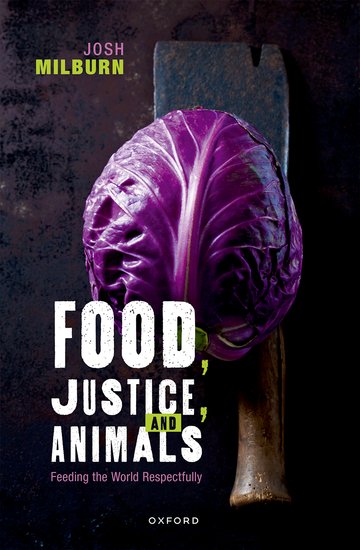
My second book, Food, Justice, and Animals: Feeding the World Respectfully, was published by Oxford University Press in 2023. The book asks what a food system in an animal-rights-respecting state would look like. It argues that, contrary to expectations, the food system would not be vegan. Meat and other ‘animal’ products could be made with plants; produced via cellular agriculture; acquired from non-sentient animals; and perhaps even acquired from sentient animals using genuinely rights-respecting forms of agriculture.
You can read about the book on the Oxford University Press website here. You can find a discount code for ordering the book from the Oxford University Press website in this Tweet.
In 2025, the book was shortlisted for the Australasian Animal Studies Association’s inaugural Siobhan O’Sullivan Book Prize, alongside Yamini Narayanan’s Mother Cow, Mother India: A Multispecies Politics of Dairy in India and Doris Schneeberger’s Envisioning a Better Future for Nonhuman Animals: Towards Future Animal Rights Declarations. The winner will be announced in November.
I have presented ideas from the book in many places, but a particular highlight was delivering a keynote presentation at EurSafe 2024 in Ede, Netherlands. You can watch a video of me presenting the arguments of the book at the 2022 Cambridge Centre for Animal Rights Law conference here, or a video of me presenting the arguments of the book (focussed on the chapter on plant-based meat) to the Culinary Minds Research Group at the University of Milan in 2022 here. I also wrote an accessible article for the magazine Persuasion setting out some of the core contentions of the book, which you can read here.
I spoke to Kyle Johannsen about the book for the New Books Network, which named it their ‘Book of the Day’ for 15 June 2023. You can listen to that interview here. I spoke to Claudia Hirtenfelder about the book for a bonus episode of The Animal Turn podcast. You can listen to that conversation here. I was also invited to apply the ‘page 99 test’ to the book (read my reflections here) and spoke to Kim Stallwood about it in a wide-ranging interview.
The book was reviewed for the German-language journal TIERethik by Arianna Ferrari (you can read the review here), for the Journal of Applied Philosophy by Joshua Jarvis-Campbell (you can read the review here), for Utilitas by Nicolas Delon (you can read the review here), for Between the Species by B.V.E. Hyde (you can read the review, which is scathing, here; versions of my response were published on my website here and in Between the Species here), and for Environmental Philosophy by John Hadley (the review is here, and you can see a paywall-free pre-publication version here).
The book was ‘recommended’ in a book note in the April 2024 issue of Choice magazine by Christine Kovic, and discussed at length in a review essay by Andrew Biro in The Review of Politics (you can read the essay here). The book was also one of the subjects of a double review (alongside my Food, Justice, and Animals) in Humanimalia, written by the philosophers Carlo Salzani and Zipporah Weisberg, which you can read here.
The book was a subject of an 2022 event called ‘Vegan Vs. Vegan‘, hosted by the British Academy in London. The event took the form of a debate between me and Corey Lee Wrenn, hosted by the actor and activist Evanna Lynch. You can read Wrenn’s comments here. (An earlier version of this event, featuring a conversation between me and Ed Winters, was sadly cancelled due to the 2020 pandemic.)
A workshop on the book (and Anne Barnhill and Matteo Bonotti’s Healthy Eating Policy and Political Philosophy) was held at John Cabot University in Rome in 2022. It featured comments from Aurélia Bardon, Rossella De Bernardi, Gianfranco Pellegrino, Simone Pollo, Tom Bailey, and Valentina Gentile. A symposium partially based on this workshop is in the process of being published in the Critical Review of International Social and Political Philosophy. It features the following articles:
- ‘Healthy eating policy and political philosophy and Food, justice, and animals: synopses and critical issues‘, by Tom Bailey
- ‘Public reason and food policy‘, by Aurélia Bardon, Rossella De Bernardi and Valentina Gentile (open access)
- ‘Cosmetic liberalism, or narrowing the boundaries of the reasonable‘, by Gianfranco Pellegrino
- ‘Children’s health, animals’ agency and market values‘, by Tom Bailey
- ‘Farming insects in the zoopolis?‘, by Bob Fischer
- ‘Why aquatic animals matter for food justice‘, by Chiawen Chiang and Jeff Sebo (open access)
- ‘Ideals are important, but our reality has other ideas‘, by Garrath Williams (open access)
- ‘Rethinking healthy eating policy and public reason: a reply to commentators‘, by Anne Barnhill and Matteo Bonotti
- ‘Liberal political philosophy and animal rights: a reply to commentators‘, by me
Here is some praise the book has received:
‘Milburn brings welcome nuance to the discussion of animals’ political rights and stands out from an overwhelmingly anthropocentric literature on “food justice.” Few books in the field can provoke and engage readers from a wide range of persuasions like this one. Lucidly written, richly informed, impeccably structured, and conscientiously argued, it should be read by anyone interested in animal ethics, animal political theory, and food studies. A short review cannot do justice to the book’s level of detail – Milburn’s evocative descriptions of many cuisines and traditional dishes worldwide – or the crisp and precise yet witty and lively style.’ – Nicolas Delon, College of Charleston, reviewing the book in Utilitas
‘[Milburn’s] analytical approach provides a set of arguments that is rigorous and carefully reasoned. But it is not dry and is indeed at times—as in his characterization of industrial-scale slaughter in our current food system (192)—quite emotive. In the conclusion Milburn describes how his thinking changed over the course of writing the book, away from his earlier presumption “that animal rights meant veganism” (185). He describes his discomfort in having his initial assumptions unsettled, and concludes that “serious research and reflection can lead to conclusions that are both alarming and correct” (185; emphasis original). His candor and openness to change is particularly remarkable and exemplary.’ – Andrew Biro, Acadia University, in a review essay in The Review of Politics
‘Milburn’s writing style is clear, accessible, and engaging, presenting complex philosophical debates in a straightforward manner, which allows the reader to follow along easily. Even if we do not agree with many of his proposals, especially in [Food, Justice, and Animals], we applaud Milburn for the sophistication and honesty with which he approaches his analyses. Both [Just Fodder and Food, Justice and Animals] make important contributions to the scholarship on animal rights and should be read by anyone interested in how issues of food and food justice are central to the whole debate about justice for animals. … In the end, although we disagree on many points, both [Just Fodder and Food, Justice, and Animals] have given us much food for thought. We admire Milburn’s courage in taking on difficult issues and applaud his rigorous reasoning and imaginative vision of (food) justice for humans and other animals. Milburn has certainly started an important conversation — or taken an existing conversation to a much more advanced stage — and opened up the floor for a lively and constructive debate.‘ – Carlo Salzani, Messerli Research Institute, and Zipporah Weisberg, University of Ottawa, reviewing Just Fodder and Food, Justice, and Animals for Humanimalia
‘This book is ambitious … Milburn has done well to produce a normative theory that is ideal yet foreseeably realizable. He painstakingly addresses objections to his arguments and explains at length the latest dietary technologies. He garnishes the text with disturbing details of dietary customs.’ – John Hadley, Western Sydney University, in a review in Environmental Philosophy
‘Josh Milburn intriguingly proposes that many animal products might be used for food or other purposes, whilst still respecting animals’ rights. For those who aspire toward lifestyles free of animal exploitation, this is nothing less than paradigm-shifting. This highly readable and engaging book deserves widespread consideration by all who are concerned about the ethics, and consequences of, our modern livestock production systems. And given the severity of the environmental and animal welfare problems they create, this should be all of us.’ – Andrew Knight, University of Winchester, via Oxford University Press
‘This book is not an attack on veganism … I view it very much as saying “If we’re going to put forward an idea of a future in which animals are treated well, we do need to take seriously the arguments that are pitted against veganism.” … I really do commend [Milburn] on an excellent piece of work that got me thinking in all sorts of directions.’ – Claudia Hirtenfelder, Queen’s University, on the podcast Animal Turn
‘Overall, Milburn’s book is intelligent, innovative, and challenging. He argues subtly and analyzes many counterarguments.’ – Arianna Ferrari, freelance, reviewing the book in TIERethik (translated from German)
‘It is rare to find a book which convincingly argues that eating animal-based foods is compatible with fully respecting the rights of animals. In Food, Justice, and Animals, Josh Milburn successfully shows that it can be done. … The value of Milburn’s work … cannot be [over]stated. [Food, Justice, and Animals is] detailed, well-argued, and exceptionally clear … Milburn has persuasively shown that we can, as he might put it, have our cow and eat her too.‘ – Joshua Jarvis-Campbell, University of Exeter, reviewing the book in the Journal of Applied Philosophy
 Josh Milburn